
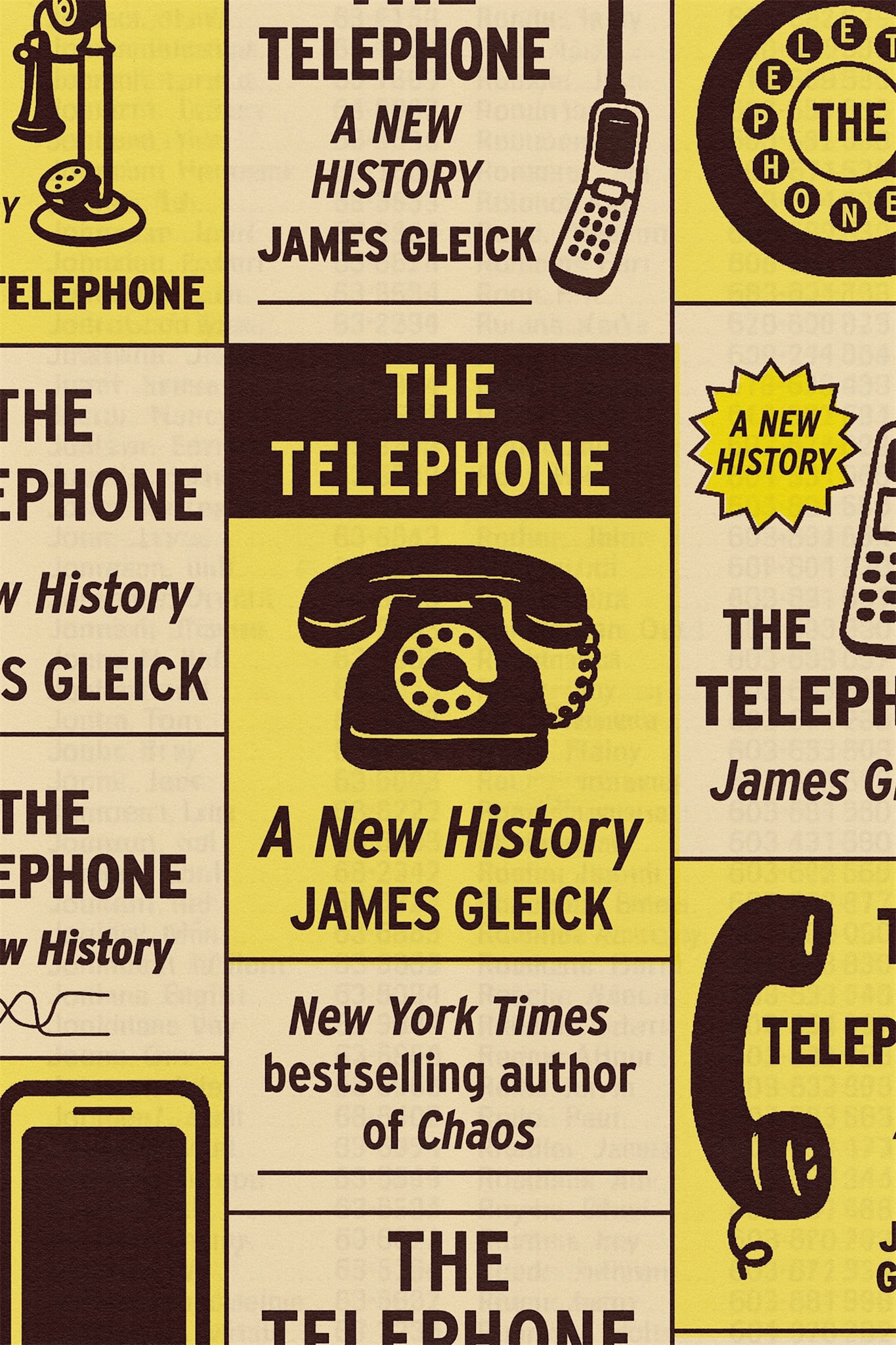


The Telephone: A New History
By James Gleick
$35.00
Add to wishlist
/
Add to compare
Publication Date: November 10, 2026
| Availability: | Out of stock, but more on the way Pre-orders ship after the publication date. |
From the bestselling author of Chaos and The Information, a sweeping history of the instrument that created modern life.
In 1876, Alexander Graham Bell said, “Mr. Watson—come here—I want to see you” into a contraption he called the telephone. For the first time, a voice was carried along a wire. This feat has long been celebrated as a triumph of individual ingenuity and vision. In fact, the invention was a contest replete with bribery, fraud, and speculation, and no one, not even its inventors, realized what it was good for or how ubiquitous it would become.
It would teach us new words and a new way to speak, with instant feeling, instant possibilities. The Bell System would become the largest monopoly in history: the maker and owner of all America’s phones. The science from Bell Labs—pulsing wires, glowing vacuum tubes, the electronic transistor—would usher in the Information Age. Along the way, the telephone changed human nature, augmenting our bodies. It gave us the party line, the busy signal, dial tones, the late-night D.J., and the booty call. It magnified the possibilities of government, business, friendship, love.
Today we are more dependent than ever on little objects called phones, although their ability to make calls is incidental. The phone book and phone booth may be vanishing from memory, but James Gleick shows the telephone’s legacy is deeply ingrained in our networks, in our sophistication about networks, in the primacy of information, in the need for connection. The Telephone: A New History is a revelation: a story of technological breakthroughs that is also a universal history of intimate life.
It would teach us new words and a new way to speak, with instant feeling, instant possibilities. The Bell System would become the largest monopoly in history: the maker and owner of all America’s phones. The science from Bell Labs—pulsing wires, glowing vacuum tubes, the electronic transistor—would usher in the Information Age. Along the way, the telephone changed human nature, augmenting our bodies. It gave us the party line, the busy signal, dial tones, the late-night D.J., and the booty call. It magnified the possibilities of government, business, friendship, love.
Today we are more dependent than ever on little objects called phones, although their ability to make calls is incidental. The phone book and phone booth may be vanishing from memory, but James Gleick shows the telephone’s legacy is deeply ingrained in our networks, in our sophistication about networks, in the primacy of information, in the need for connection. The Telephone: A New History is a revelation: a story of technological breakthroughs that is also a universal history of intimate life.
About the Author
No reviews yet. Be the first to write a review.